

The Evolution of Chilled Water Plant Optimization: From First Principles to Guideline 36
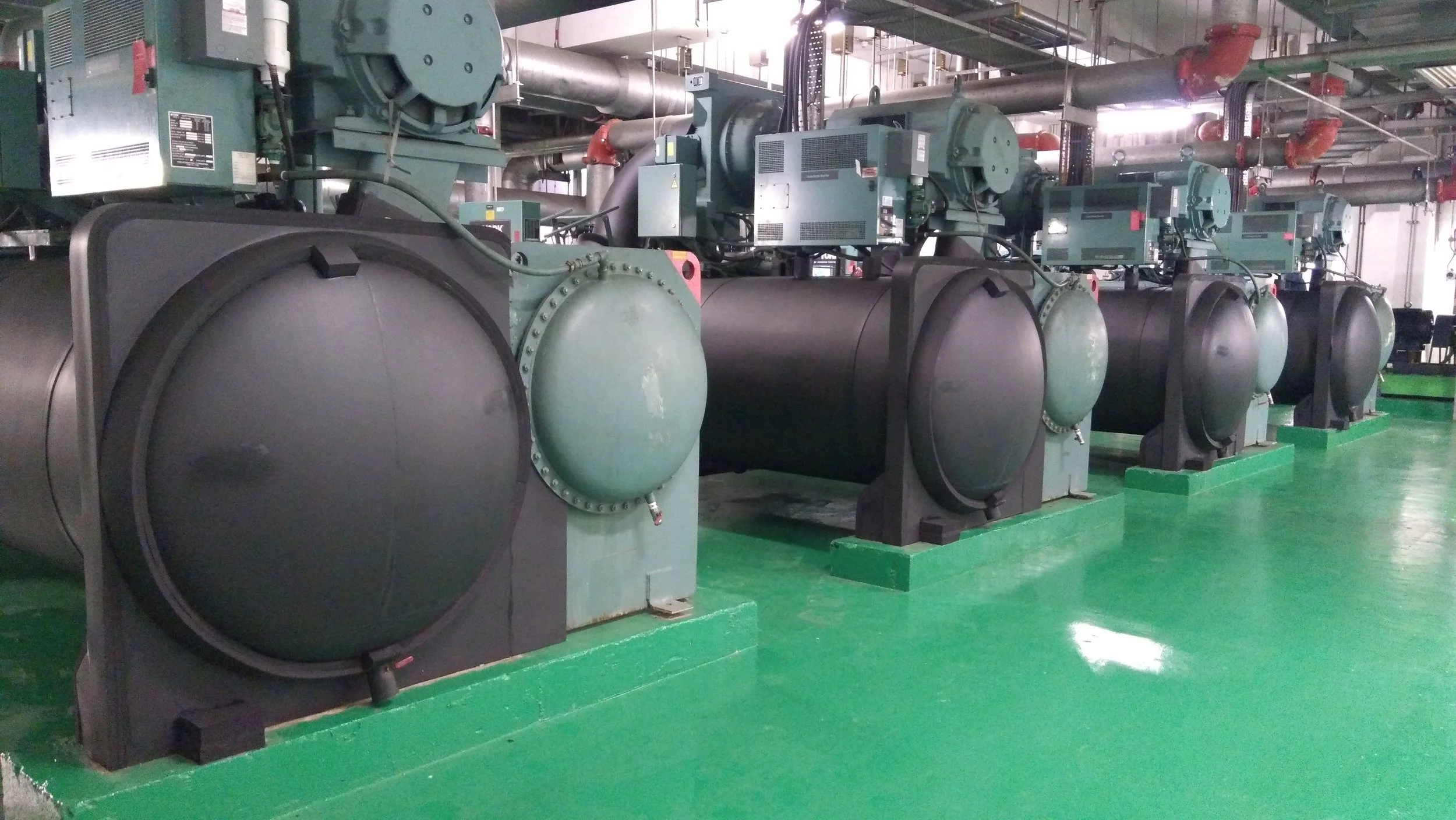
Central chilled water plants are the largest electrical loads in most commercial and institutional buildings. Small changes in how they operate produce large, persistent energy impacts. For decades, engineers worked to optimize these systems, but through the 2000s and 2010s, most practical optimization remained proprietary, implemented through closed algorithms offered by specialized firms like Optimum Energy, tekWorx, and Siemens.
ASHRAE Guideline 36 Section 5.20, first published in 2021, changed that. None of the individual concepts were new. But until 2021, they existed as scattered research, proprietary platforms, and tribal knowledge. Steve Taylor and the G36 committee pulled them into a single, open framework any engineer could reference, specify, and commission.
Understanding how we got here means tracing the evolution from hydronic fundamentals through modern control strategies.
1970s: Hydronic Fundamentals Set the Stage
Erwin G. Hansen's work in the 1970s defined the constraints that make optimization possible. His focus was hydronic compatibility in large central systems: preserving chilled water temperature differential (ΔT), avoiding constant-flow secondary loops with three-way valves, and designing primary-secondary interfaces that don't force excessive flow or pumping energy.
These are prerequisites. Without stable ΔT and proper hydraulic design, optimization strategies fail regardless of control sophistication. Hansen's principles remain the foundation of modern central plant design and control sequences.
Late 1980s: James Braun Formalizes Integrated Plant Optimization
James E. Braun's 1988 doctoral work at the University of Wisconsin-Madison formalized chilled water plant optimization as a coupled-system problem. Chillers, chilled water pumps, condenser water pumps, and cooling towers must be optimized together, not individually. The objective is minimum total plant energy, and optimal operating points vary with load and ambient conditions, particularly outdoor wet-bulb temperature.
Braun also showed how the theory could be reduced to practical supervisory control strategies that worked in real systems. His work became the foundation for ASHRAE Handbook Applications, Chapter 42: Supervisory Control Strategies and Optimization (Chapter 41 in earlier editions), which documents "near-optimal" control methods for central cooling plants. These near-optimal strategies use simplified correlations and sequencing rules that approximate full optimization without requiring complex real-time calculations. Chapter 42 remains the technical reference for tower fan sequencing, condenser water temperature reset, chilled water temperature reset, and differential pressure reset strategies that many commercial optimization platforms later built upon.
1990s–2000s: Variable Speed Drives Change the Game
As variable-speed drives became common, optimization thinking shifted from static analysis to operational control. A number of engineers drove this transition.
Wayne Kirsner focused on variable-speed pumping, variable primary operation, and the operational consequences of low chilled water ΔT, reinforcing that distribution system performance, more than chiller nameplate efficiency, often constrains plant efficiency. Mick Schwedler, through years of Trane Engineers Newsletter articles and ASHRAE leadership, translated optimization concepts into applied design and control guidance that many engineers internalized before the ideas appeared in formal standards.
Thomas Hartman introduced the concept of equal marginal performance: the condition where no incremental adjustment to one component improves overall plant efficiency. Control philosophy shifted from fixed setpoints to outcome-based strategies where setpoints adjust to reduce total plant power. Hartman's work became the technical foundation of Optimum Energy's optimization platform.
Burt Rishel brought rigor to pumping optimization through his focus on wire-to-water efficiency, emphasizing that pumping energy includes motor losses, drive losses, and system losses from staging and piping configuration. His approach became the basis for tekWorx's pump optimization capabilities.
Hemant Mehta advanced practical pumping optimization in the 2000s by advocating for the conversion of primary-secondary chilled water systems to variable primary flow, eliminating redundant constant-speed primary pumps and simplifying plant hydraulics. Mehta also pushed for minimal use of booster pumps throughout campus distribution systems, relying instead on properly controlled central distribution pumps. This reduced equipment count, simplified operations, and improved overall system efficiency. Just as important, restoring ΔT and converting to variable primary flow recovers chiller capacity that low ΔT plants have effectively given away, often deferring or eliminating the need to add new chillers.
2000s–2010s: Proprietary Platforms Demonstrate What's Possible
By the mid-2000s, the theoretical foundation for chilled water plant optimization was well established, but practical implementation remained inconsistent. A new generation of specialized companies emerged, offering continuous, adaptive optimization as proprietary commercial services.
These platforms had distinct technical emphases. Optimum Energy, built on Hartman's work, focused on optimized condenser water temperature and chiller lift management. Siemens Demand Flow emphasized condenser water flow optimization using variable-speed condenser water pumps. tekWorx, rooted in Rishel's wire-to-water approach, built strong pump optimization capabilities. Kiltech focused on chiller plant optimization, particularly plants with magnetic bearing chillers.
These platforms demonstrated that meaningful energy savings were achievable. However, they relied on closed algorithms that were difficult for owners and operators to inspect, troubleshoot, or adapt. By the early 2010s, the industry had multiple commercial optimization approaches and little standardization.
Mid-2010s: ASHRAE Research Project RP-1711 Documents What Works
RP-1711 started from a simple premise: survey the chilled water plant control sequences that were already working in the field, figure out what they had in common, and write it down. Led by Steve Taylor and others, the research drew from consulting engineers, controls contractors, major OEMs, commissioning providers, and researchers to identify common features that consistently delivered energy savings across different plant configurations.
The value came from the process itself.
RP-1711 provided a systematic, industry-wide synthesis of what actually works. The research drew from a structured review of successful plant sequences from consulting engineers, controls contractors, major OEMs, commissioning providers, and researchers, then distilled them into a single, coherent framework. That combination of technical credibility and practical grounding gave it unusual authority.
The real value was its focus on the boring mistakes that waste the most energy. In the field, most optimization dollars are lost to basic design and sequence errors. Poor chiller staging logic. Plants fighting themselves through unnecessary throttling. Uncontrolled bypass flow. Pump control that ignores actual system demand. Tower control that leaves lift savings on the table.
Even sites with overlay optimization platforms often still suffer from these underlying sequencing flaws. RP-1711 attacked the root plant control logic.
The research also defined controls hygiene as a baseline. It pushed vendors toward clean, structured, ready-to-use sequences with sensible VFD control structures, stable reset logic, clear staging hierarchies, and defined alarm philosophy tied to operating modes. Instead of every BAS programmer inventing their own plant logic from scratch, there was now a tested backbone to start from.
This shifted optimization to a built-in feature. The base sequences now embedded optimization directly: chilled water supply temperature reset driven by load, lift-aware chiller staging, tower control tied to plant efficiency, waterside economizer logic that adapts. Even without a supervisory optimization layer, a plant could operate at a high performance baseline.
RP-1711 logic was implemented in real DDC platforms, built into example plants, simulated under operation, and audited back to the written sequences. That addressed the gap between sequence intent and what actually runs in the controller, which is where most projects fall apart.
The research raised the minimum bar for the industry. Once vendors ship configurable plant logic based on this framework, the floor moves up. Fewer wildly inconsistent plant sequences from project to project. Easier peer review and commissioning. A common technical language for engineers, commissioning agents, and BAS teams.
It helped turn high-performance plant control from an art into a repeatable engineering practice.
From Research Project to ASHRAE Guideline 36
RP-1711 was designed from the start to become part of ASHRAE Guideline 36. The research project's final task explicitly stated the outcome would be plain-language hydronic sequences ready for adoption into the Guideline as an addendum, subject to public review before formal adoption. Steve Taylor, who co-led RP-1711, was also a principal author and driving force behind Guideline 36 itself, so the research and the standard were tightly connected from the beginning.
The path from research to standard followed ASHRAE's formal addendum process. The Guideline 36 project committee took RP-1711's content and edited it into Guideline 36 format, resolved conflicts with existing sections, aligned terminology and definitions, and prepared the public review draft package.
Public review is where the real work happens. ASHRAE runs drafts through an online comment system where the project committee responds to each comment, makes revisions, and may trigger additional review cycles as needed. After public review and comment resolution, the addendum is approved and published.
Published addenda are eventually consolidated into the next full Guideline edition. RP-1711 became Section 5.20 in ASHRAE Guideline 36-2021, marking the first time chilled water plant optimization moved from a collection of proprietary approaches into a standardized, referenceable sequence framework.
Section 5.20 takes a framework approach. It defines a structured method for sequencing and resetting chillers, pumps, and cooling towers based on system-level energy priorities, without prescribing a specific algorithm. Chilled water supply temperature reset is prioritized as a primary efficiency lever. Chilled water differential pressure reset is treated as secondary and supportive. Condenser water control strategies must account for load and chiller characteristics. Chiller staging logic must consider part-load efficiency, not just capacity. Optimization sequences must be compatible with real plant constraints and operational limits.
Practical Engineering Judgment on Section 5.20
Guideline 36 is an exceptional resource. It gives peer-reviewed, vetted collective judgment on chilled water optimization, and it is open for anyone to read. That alone is a significant shift from the proprietary era.
That said, some parts of Section 5.20 are more suited to a complete plant controls upgrade than a typical retrofit. The full condenser water reset strategy, for example, is excellent engineering, but it requires focused commissioning time and instrumentation that many existing plants do not have in place. Implementing the entire section from scratch on an older plant with limited BAS infrastructure is a significant undertaking.
The practical takeaway is that you do not have to implement the whole thing to get massive value. You can extract the most important, no-brainer pieces and capture the majority of the available savings: pump staging logic, the basic concept behind condenser water reset, cooling tower cell staging, and evaluating whether your plant can do chilled water supply temperature reset. Those four items alone address the biggest energy waste in most plants.
A well-scoped partial implementation of G36 concepts, targeted at the specific inefficiencies in your plant, will outperform a full implementation that never gets commissioned properly.
What Guideline 36 Changed
Chilled water plant optimization is not new. Over decades, the industry learned that efficiency starts with fundamentals: proper pump selection, maintaining system ΔT, and avoiding designs that fight the physics of the plant.
What changed with ASHRAE Guideline 36 Section 5.20 is that these principles are now codified in a peer-reviewed guideline, implemented and tested across system types, and accessible to any engineer or controls contractor. Section 5.20 represents years of field experience and best-practice programming, driven largely by Steve Taylor's work through RP-1711 and the Guideline 36 committee, distilled into a common framework. Section 5.20 is programming hygiene: stable control loops, sensible reset strategies, proper staging logic, and clear operational intent.
The sequences are transparent, commissionable, and debuggable. For owners, Section 5.20 defines what high-performance plant control should look like. For engineers, it provides a defensible basis for specifying and commissioning optimization strategies. For existing plants, it offers a roadmap for meaningful savings without relying on proprietary platforms.
As Guideline 36 is adopted more widely, operators moving between buildings will encounter consistent principles rather than custom schemes. That consistency improves not only energy performance, but also long-term operability and understanding across the industry. For more on how Guideline 36 applies to real-world building operations, see our full series on ASHRAE Guideline 36.
The Human Side: Earning Operator Trust
None of this matters if the people running the plant don't trust the system. The operators are responsible for the most critical job in a chilled water plant: delivering reliable chilled water to the building. They have seen "smart" systems come and go. If they do not understand how the optimization works, or if they do not believe in the core principles behind it, they will put the system back in hand. When that happens, every dollar and hour you invested in the platform walks out the door.
The approach needs to be operator-training-first. Before you commission the optimization, everyone who will put their hands on the system needs to be on board. That means walking through the control logic, explaining why the system makes the decisions it does, and giving operators enough understanding to see if something that actually needs intervention. Expect this to take time. One training session won't do it. Building operator confidence is an ongoing process of showing them why the system makes the decisions it does.
If you skip this step, the rest of the investment is at risk. Operator buy-in is arguably the single highest-value line item in any optimization project. You need an engineer who can sit with the operators and build that trust, someone who speaks their language and respects the weight of what they are protecting.
Where to Start
If you are looking at your chilled water plant and wondering where to start, that is exactly what our engineering services cover. We work with building owners and facility teams to figure out which pieces of Guideline 36 make sense for a given plant and budget, whether that means a full controls upgrade or pulling out the three or four highest-impact changes and implementing them as part of a targeted retrofit. Many of these improvements qualify for utility rebate incentives. The goal is real savings from practical improvements. If you want to talk through what makes sense for your plant, get in touch.
References
1. ASHRAE Guideline 36-2021, High-Performance Sequences of Operation for HVAC Systems, Section 5.20
2. Hansen, E.G., Hydronic System Design and Operation: A Guide to Heating and Cooling with Water. New York: McGraw-Hill, 1985
3. Hansen, E.G., "Central Chilled Water Distribution Systems Design," ASHRAE Journal, 1974; reprinted April 2009
4. Braun, J.E., Methodologies for the Design and Control of Central Cooling Plants, PhD Dissertation, University of Wisconsin-Madison, 1988
5. ASHRAE Handbook, HVAC Applications, Chapter 42: Supervisory Control Strategies and Optimization, 2023 (originally Chapter 41 in the 2007 edition)
6. Hartman, T., "All-Variable Speed Centrifugal Chiller Plants," ASHRAE Journal, September 2001
7. Rishel, J.B., "Wire-to-Water Efficiency of Pumping Systems," ASHRAE Journal, 2001
8. Mehta, H., "Primary-Only vs. Primary-Secondary Variable Flow Systems," District Energy, Third Quarter 2016
9. Mehta, H., "How to Convert and Optimize Primary/Secondary Pumping Systems to Variable Flow Primary Systems," WM Group Engineers, P.C.
10. ASHRAE Research Project RP-1711, "Advanced Sequences of Operation for HVAC Systems, Phase II: Central Plants and Hydronic Systems," Steven T. Taylor et al., Final Report, December 2019
11. Taylor, S.T., "Optimizing Design and Control of Chilled Water Plants," ASHRAE Journal, Parts 1–5, 2012
12. Kirsner, W., "Rectifying the Primary-Secondary Paradigm for Chilled Water Plant Design to Deal with Low ΔT Central Plant Syndrome," HPAC Heating/Piping/AirConditioning, January 1998
13. Hartman, T., "Designing Efficient Systems with the Equal Marginal Performance Principle," ASHRAE Journal, Vol. 47, No. 7, July 2005